
A simple idea with fascinating science
Hydrogen water is drinking water enriched with dissolved molecular hydrogen gas (H₂). It is colourless, odourless and distinct from both hydrogen peroxide and alkaline water. Researchers around the world are studying how this exceptionally small molecule may support oxidative balance, recovery and wider wellbeing.
The appeal is beautifully straightforward: prepare fresh hydrogen-rich water at home and enjoy it as part of your normal hydration routine. Understanding dissolved H₂, freshness and the machine’s daily routine helps you choose with confidence.
How Is Hydrogen Water Made?
Commercial products generally use one of three approaches:
- Electrolysis: electrodes generate hydrogen from water, often with a membrane separating gas streams.
- Gas infusion: hydrogen gas is dissolved into water under controlled conditions.
- Magnesium tablets or sticks: a chemical reaction releases hydrogen into water, normally in a sealed container.
The resulting water should be described by its dissolved molecular-hydrogen concentration, commonly in milligrams per litre (mg/L) or parts per million (ppm). In a dilute water solution, 1 mg/L is approximately 1 ppm.
Hydrogen is a remarkably small and naturally mobile molecule. Its concentration gradually changes after generation depending on the container, seal, temperature, movement and elapsed time. That is why hydrogen water is best enjoyed freshly prepared.
The useful measurement
Dissolved H₂ at the point and time of drinking is the clearest way to describe hydrogen-rich water. Source water, temperature, test method and elapsed time make the measurement easier to understand and compare.
Hydrogen Water Is Not the Same as Alkaline Water
Alkaline water is defined by a higher pH. Hydrogen-rich water is defined by dissolved H₂. Some electrolysis processes can affect both, which is why the terms are often mixed together, but they remain separate measurements.
Scroll table horizontally →
| Measurement | What it describes | Why it is useful |
|---|---|---|
| Dissolved H₂ (mg/L or ppm) | Molecular hydrogen remaining in the sampled water under the stated test conditions | The most direct description of hydrogen-rich water |
| pH | How acidic or alkaline the water is | Helps explain the water’s acid–alkaline balance |
| ORP (mV) | Electrochemical potential under the sample and meter conditions | A supporting electrochemical reading influenced by several factors |
| Gas volume or visible bubbles | Gas production or gas present in and around the water | Creates the fresh, lively appearance seen after dispensing |
A 2022 analysis modelled how pH, temperature and hydrogen affect oxidation-reduction potential. It showed why direct dissolved-H₂ testing gives a clearer hydrogen measurement than ORP alone, which can also shift substantially with pH.
Our alkaline-versus-hydrogen guide compares the two categories in more detail.
Why Are Researchers Interested in Hydrogen Water?
Molecular hydrogen has developed into an active international research field. Human studies are exploring exercise recovery, metabolism, cardiovascular markers, mental wellbeing and healthy ageing, alongside extensive laboratory work on oxidative balance and cellular signalling.
A 2024 systematic review brought together 25 human studies across exercise capacity, metabolism, cardiovascular measures, mental health and other topics. The variety of populations and protocols reflects how widely researchers are now exploring hydrogen-rich water.
Scroll table horizontally →
| Research | What was explored | Why it is interesting |
|---|---|---|
| 2024 systematic review | Twenty-five human studies across several health areas | Shows the breadth of human research already underway |
| Crossover cycling trial | Lactate, ventilation and perceived exertion during exercise | Explores how hydrogen water may relate to exertion and recovery |
| Crossover running trial | Treadmill performance and physiological responses | Adds useful data about acute use in trained runners |
| 2024 lipid meta-analysis | Eight trials and 357 participants across several lipid measures | Brings multiple metabolic studies into one analysis |
| 2026 lipid meta-analysis | Thirteen trials and 757 participants examining total and LDL cholesterol | Shows the field continuing to grow in size and depth |
Together, these studies show that hydrogen water has moved beyond a laboratory idea into sustained human investigation. Researchers are now working toward larger studies, more consistent protocols and a clearer understanding of which routines and populations may benefit most.
Hydrogen as a Beverage Ingredient
The US Food and Drug Administration database records a 2014 Generally Recognized as Safe notice—GRN 520—for hydrogen gas used as an ingredient in drinking water, flavoured beverages and soda drinks at the stated intended-use level. The FDA responded that it had “no questions” about the notifier’s GRAS conclusion for that ingredient use.
This food-ingredient record is useful context alongside the much broader body of research into hydrogen-rich water. Product choice still comes down to the exact appliance, source water, preparation method and everyday ownership experience.
An Easy Addition to Your Hydration Routine
Hydrogen-rich water is designed to be enjoyed as drinking water. The best experience begins with the correct source water, a clean appliance and freshly prepared water consumed soon after dispensing.
Velta provides product-specific setup, cleaning and servicing guidance for Malaysian customers. If you have a medical condition, are pregnant or have questions about combining any wellness routine with prescribed care, your healthcare professional can advise you personally.
How to Choose a Hydrogen-Water Generator
1. Understand the hydrogen measurement
Dissolved H₂ in mg/L or ppm, measured at a stated point, time and temperature, makes product information easier to understand. Gas volume, bubble appearance and ORP describe different parts of the experience.
2. Explore how it was tested
A useful report identifies the exact model, laboratory, test date, source water, temperature and measurement method. Results immediately after generation and after a realistic standing period help show why fresh preparation matters.
3. Look at the complete product
Electrical safety, electromagnetic compatibility, restricted-substance, quality-management and food-contact documents each describe a different aspect of the appliance and its manufacturing.
4. Check the practical ownership details
Compare the required source water, tank size, dispense time, cleaning, footprint, power, warranty, local servicing and replacement parts. The best machine is one that fits naturally into your kitchen and encourages a consistent routine.
5. Experience it for yourself
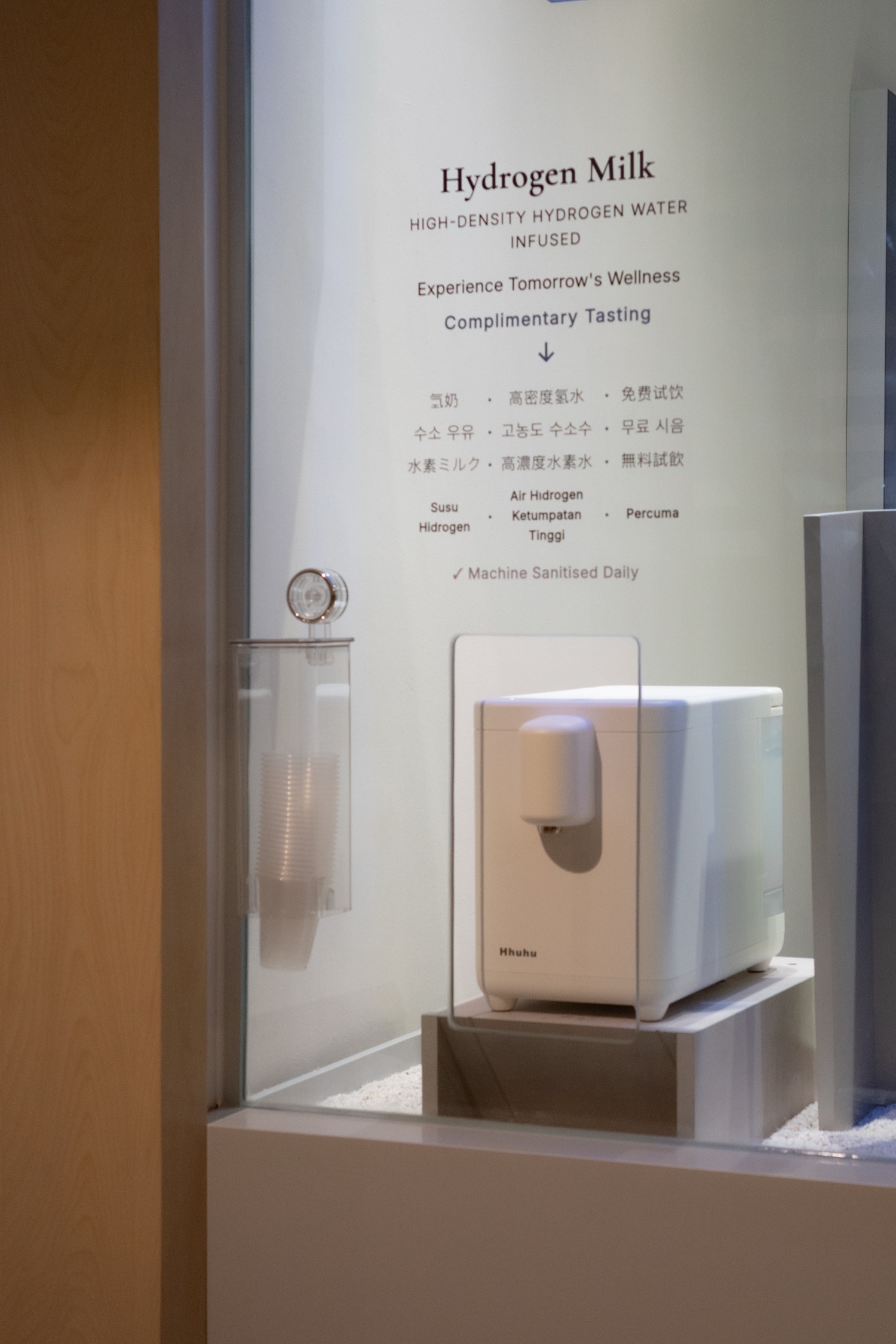
A demonstration lets you see the water’s freshly dispensed appearance, hear the machine, handle the removable tank and understand the complete daily routine before choosing.
What the Current Hhuhu Malaysia Manual Documents
Hhuhu is a point-of-use hydrogen-water generator, not a tap-water purifier. Its current Malaysia manual requires compatible purified, distilled or reverse-osmosis source water and describes a visible milky appearance caused by micro- and nano-sized bubbles. The appearance fades as bubbles leave the water; it is not a dissolved-H₂ measurement.
Scroll table horizontally →
| Item | Current Malaysia documentation | What it means at home |
|---|---|---|
| Machine price | RM7,798.00 | Live catalogue pricing is shown on the product page |
| Source water | Purified, distilled or RO water; room temperature; manual guidance uses very low TDS | Pairs naturally with a compatible purified-water source |
| Purification | No replacement filter and no tap-water treatment stage | A dedicated hydrogen-water appliance without filter changes |
| Tank and dispense | 3,000 ml removable rear tank; documented 15-second dispensing cycle | Allow refill, removal and drying space behind the appliance |
| Dimensions and weight | 223 W × 476 D × 326 H mm; under 9 kg | Measure counter depth as well as body width |
| Power | 200 W; 100–240 V, 50/60 Hz | Use a safe, dry and accessible power point |
| Cleaning | Clean the water tank every two weeks | Plan a repeatable removal, washing, drying and reseating routine |
| Warranty | Two years in the current Malaysia manual | Confirm covered parts, proof-of-purchase and service process |
| Hydrogen experience | Freshly prepared water with a visible micro- and nano-bubble appearance | Enjoy soon after dispensing as part of your hydration routine |
For the best ownership experience, use compatible purified, distilled or RO water with TDS below 10 and follow the simple tank-cleaning routine in the manual. Velta Malaysia can confirm that your existing water source is suitable.
Read the local Hhuhu manual (PDF) or review the Hhuhu product page.
What to Explore During a Demonstration
- 01See freshly prepared hydrogen water.
Observe its appearance at the point of drinking and learn how freshness is preserved.
- 02Explore the model’s documentation.
Review its specifications, source-water guidance, warranty and included accessories.
- 03Understand the different measurements.
Let our team explain dissolved concentration, gas production, bubbles and ORP in plain language.
- 04How quickly does concentration decline?
Ask for results in the supplied glass or container over the time you would actually drink it.
- 05What source water is required?
Check the purifier, water temperature and TDS conditions used for the test and required at home.
- 06How are all water-contact parts cleaned?
Remove, inspect and reseat the tank during the demonstration if possible.
- 07What does the Malaysia warranty cover?
Confirm labour, transport, exclusions, response route and replacement-part availability.
- 08How can it fit into my routine?
Talk through your household size, water source, counter space and preferred drinking habits.
Common questions
Frequently Asked Questions
Does hydrogen water taste different?
Molecular hydrogen is colourless and odourless. Taste can still differ because of the source water, minerals, temperature, device materials or cleaning condition. The Hhuhu manual describes a milky visual effect from small bubbles, not a flavour additive.
How much hydrogen water can I enjoy?
Hydrogen water is designed to complement your normal hydration routine. Research protocols use different volumes and timings, while your Hhuhu demonstration and product guidance will show you a convenient everyday routine.
How long does dissolved hydrogen last?
Hydrogen gradually disperses after preparation. The initial concentration, container, seal, temperature and movement all play a part, so the simplest approach is also the most enjoyable: prepare it fresh and drink it soon after dispensing.
Is a higher ppm always better?
A meaningful comparison starts with a valid direct measurement of dissolved H₂ under stated conditions. Freshness, the drinking experience and how naturally the machine fits your routine matter alongside the number.
What benefits are researchers exploring?
Human studies are exploring exercise recovery, oxidative balance, metabolic markers, cardiovascular measures, mental wellbeing and healthy ageing. Visit our hydrogen research library to read the original studies and reviews.
What water does Hhuhu use?
Hhuhu works with compatible purified, distilled or reverse-osmosis water at room temperature and TDS below 10. It is a dedicated hydrogen-water generator, making it an excellent companion to a suitable purified-water source.
Sources checked 13 August 2026
Primary research, official guidance and product documentation
- Dhillon et al. (2024): systematic review of human hydrogen-water research
- Botek et al. (2019): crossover trial of ventilatory, perceptual and lactate responses
- Ooi et al. (2020): crossover treadmill-performance trial in trained runners
- Jamialahmadi et al. (2024): systematic review and meta-analysis of blood lipids
- 2026 systematic review and meta-analysis of lipid profiles in adults with overweight or obesity
- LeBaron and Sharpe (2022): why ORP should not estimate dissolved H₂
- US FDA: GRAS Notice 520 for hydrogen gas as a food ingredient
- Medical Device Authority Malaysia: MDA/GD/0032 Code of Advertisement
- Velta Malaysia: current Hhuhu Hydrogen Milker user manual