
Scope and medical note
This comparison concerns drinking water and household appliances. It does not make a diagnosis, recommend a therapeutic dose or establish either category as treatment. Water safety depends on the complete microbiological, chemical and product context—not pH or a hydrogen reading alone.
The Short Answer
Alkaline water and hydrogen water are often conflated, but their defining properties are different.
Alkaline water has a pH above neutral. Consumer products are often promoted around pH 8–10, but the exact value and mineral composition depend on the source and process.
Hydrogen water contains dissolved molecular hydrogen gas (H₂). Its defining measurement is dissolved-H₂ concentration, usually stated in mg/L or ppm. The water can be neutral, alkaline or—depending on the source—another pH.
You can have one property without the other. Neither number by itself establishes a health outcome.
Scroll table horizontally →
| Question | Alkaline water | Hydrogen water |
|---|---|---|
| Defining feature | Raised pH | Dissolved molecular H₂ |
| Key measurement | pH under stated conditions | Direct dissolved H₂ in mg/L or ppm |
| Common production | Mineral addition or water ionisation | Electrolysis, gas infusion or magnesium reaction |
| Central marketing idea | Changing or “balancing” body pH | Antioxidant, exercise or metabolic effects |
| Evidence boundary | No basis for broad body-alkalising or disease claims | Active but early, varied human evidence; no established general-health benefit |
What Is Alkaline Water?
The pH scale describes how acidic or alkaline a water sample is. A pH of 7 is neutral at the reference conditions; values above 7 are alkaline. pH is logarithmic, so a one-unit change is not a simple one-step increase.
Malaysia’s Ministry of Health drinking-water quality standard lists an acceptable pH range of 6.5–9.0. That operational water-quality range should not be turned into a treatment claim. The World Health Organization does not set a health-based guideline value for pH at levels normally found in drinking water, but identifies pH as an important operational parameter because it affects treatment, corrosion, disinfection and acceptability.
Household alkaline water is usually produced in one of two ways:
- Mineral cartridges or additives release alkaline minerals or buffering compounds into the water. The output depends on source-water chemistry, contact time and cartridge condition.
- Water ionisers use electrolysis to separate outlet streams under the machine’s operating conditions. The alkaline stream’s pH depends on the source water, flow, electrode settings and maintenance.
The Health Claims
Marketing commonly says that modern diets make the body too acidic and that higher-pH water “balances” the body, detoxifies it or changes disease risk. These claims confuse the pH of a drink with the tightly regulated acid-base state of blood and tissues.
What the Science Says
Blood pH is normally kept within a narrow range through buffer systems plus respiratory and renal control. Drinking water can affect the contents of the digestive tract and urine chemistry in context, but that is not the same as meaningfully “alkalising” the blood of a healthy person.
A 2016 systematic review searched published and grey literature for dietary acid load or alkaline water in cancer prevention and treatment. Only one observational study met its criteria, no randomised trial was found, and no study examined alkaline water for cancer treatment. The authors concluded that promotion for cancer prevention or treatment was not justified.
A frequently cited 2012 reflux paper was an in-vitro laboratory study: pH 8.8 water inactivated pepsin in the test conditions and had buffering capacity. It did not test symptom relief or treatment outcomes in patients, so it cannot establish alkaline water as reflux treatment.
The evidence distinction
A measured pH, a laboratory effect and a patient outcome are three different levels of evidence. A higher-pH sample can be real without proving that the product changes blood pH, prevents disease or treats reflux.
What Is Hydrogen Water?
Hydrogen water is drinking water with molecular hydrogen gas (H₂) dissolved in it. This gas is additional to the hydrogen atoms already chemically bonded to oxygen in every H₂O molecule.
How It’s Made
- Electrolysis generators produce hydrogen gas from water and dissolve some of it into the outlet or tank.
- Gas-infusion systems dissolve supplied hydrogen into water under controlled conditions.
- Magnesium tablets or sticks release hydrogen through a chemical reaction, normally in a sealed vessel.
- Pre-packaged water is infused before sale, but dissolved gas can decline during storage after packaging.
The useful output is a direct dissolved-H₂ measurement at the point and time of drinking. The concentration can fall with time and depends on the starting value, seal, container, headspace, temperature and agitation.
What the Science Says
A 2024 systematic review included 25 human studies and described preliminary findings across several health areas while calling for larger samples and more rigorous methods. Trials differ in population, concentration, volume, duration and endpoint, so publication volume does not establish one general consumer benefit.
Individual exercise studies illustrate the uncertainty: a small 12-man crossover trial reported changes in lactate, ventilation and perceived effort, while a 14-runner crossover trial found no improvement in treadmill performance or measured physiological responses.
Short-term trial tolerability also does not validate every machine’s electrical, food-contact, hygiene or output claims. The US FDA’s GRAS Notice 520 concerns a specified food-ingredient use for hydrogen gas; it is not treatment approval, device approval or a recommended dose.
Our full hydrogen-water evidence guide reviews the studies, measurement traps and exact-model buyer checklist.
Head-to-Head Comparison
Scroll table horizontally →
| Feature | Alkaline water | Hydrogen water |
|---|---|---|
| Defining characteristic | pH above neutral | Dissolved molecular H₂ |
| Direct measurement | Calibrated pH measurement with conditions stated | Suitable direct dissolved-H₂ method in mg/L or ppm |
| Common methods | Mineral cartridge, additive or ioniser | Electrolysis, gas infusion or magnesium reaction |
| Proposed mechanism | Often marketed as changing internal acid-base balance | Research hypotheses involving molecular hydrogen |
| Human evidence | Does not support broad body-alkalising or disease claims | Early and heterogeneous; no established general-health outcome |
| Measurement trap | pH does not show dissolved H₂ or total water safety | ORP, bubbles and gas volume do not replace direct dissolved-H₂ |
| Source-water issue | Mineral and electrolysis output depends on source water | Each generator specifies compatible source-water conditions |
| Ownership work | Cartridge, electrode and scale maintenance as applicable | Tank or cell cleaning, compatible source water and service |
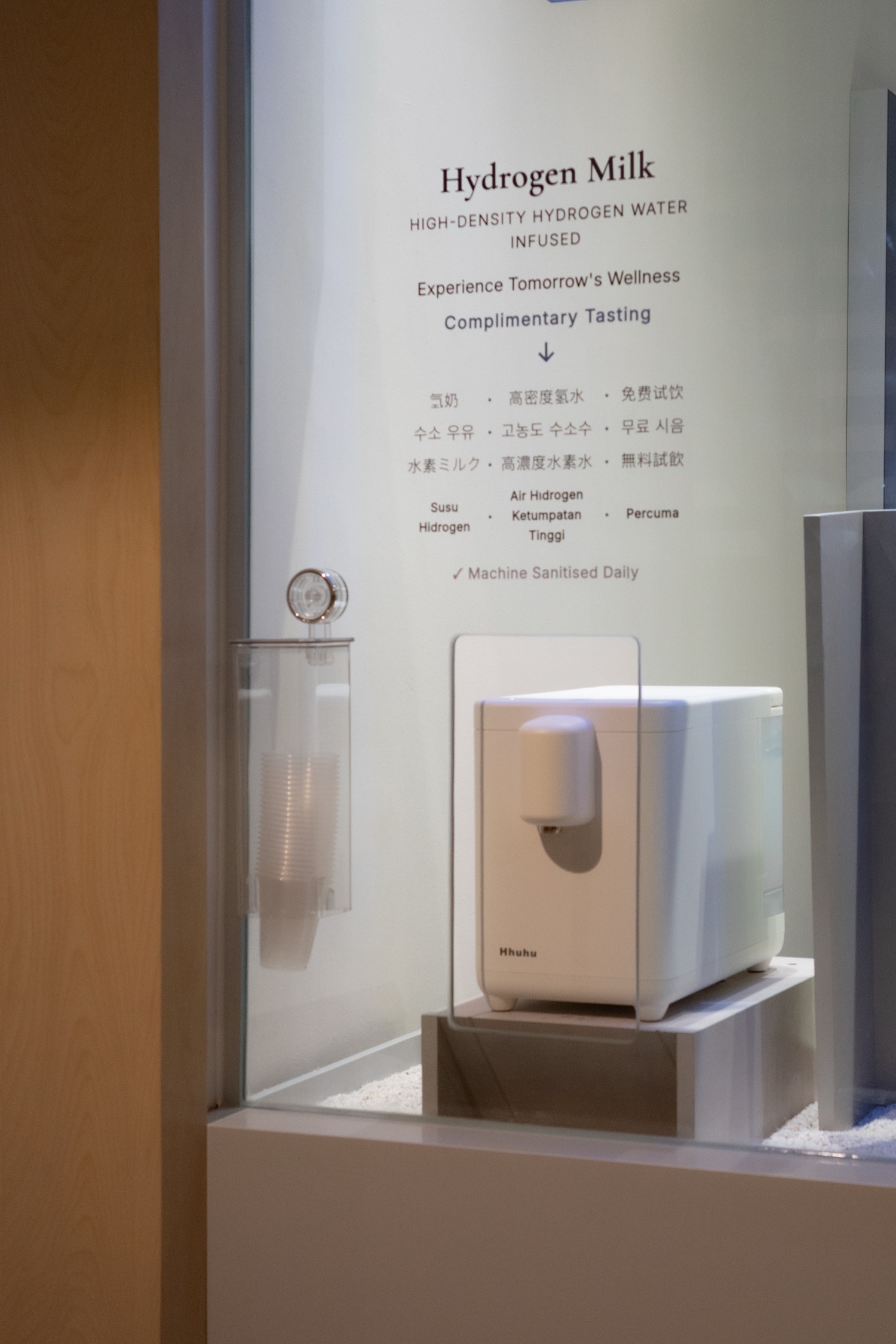
| Velta Malaysia catalogue | No dedicated alkaline-water product currently listed | Hhuhu at RM7,798.00 |
The catalogue row describes availability, not superiority. It does not supply an exact-model dissolved-H₂ result: the current Hhuhu Malaysia manual gives operating specifications but no concentration or identified laboratory report.
The Ioniser Confusion
Some water ionisers produce outlet water that is both alkaline and hydrogen-rich. Electrolysis can raise pH while also generating molecular hydrogen, so the two properties often appear together in one demonstration.
They are still independent measurements. A high pH reading does not show how much dissolved H₂ is present. A negative oxidation-reduction potential (ORP) is also not a reliable substitute: a 2022 analysis showed that pH and temperature can materially alter ORP and concluded that ORP-based meters should not be used to estimate or compare dissolved-H₂ levels.
Technology labels such as SPE or PEM describe aspects of the generation system. They do not prove the concentration reaching the glass, document water-contact safety or establish a health outcome. A meaningful comparison asks for the direct dissolved-H₂ result, source-water conditions, sample point, time, temperature, method and repeat runs.
Which Should You Choose?
Start with the job you need done. Higher-pH water, hydrogen enrichment, tap-water purification, temperature-controlled dispensing and carbonation are separate functions. A device may combine some of them, but one feature should not be assumed from another.
If taste is the aim
Compare the actual water.
Use a blind taste comparison with the intended source water. Check mineral addition, filter change and scale-management requirements without attaching a medical promise to preference.
If hydrogen is the aim
Demand direct evidence.
Ask for an exact-model dissolved-H₂ report at the point and time of drinking, then compare source water, cleaning, footprint, warranty and local service.
If purification is the aim
Check the treatment claim.
Match the filtration process and exact-model contaminant-reduction evidence to the source-water concern. pH, TDS and bubbles alone do not verify removal.
If health treatment is the aim
Use clinical care.
Neither category supports a broad promise to prevent or treat disease. Discuss symptoms, medicines, kidney function and treatment decisions with the appropriate clinician.
For Hhuhu in Malaysia, the current manual requires compatible purified, distilled or RO water, a removable 3 L tank cleaned every two weeks, and room-temperature use. It gives a two-year warranty but no dissolved-H₂ concentration or named exact-model report. Treat the manual as operating documentation and ask separately for current output evidence.
Common questions
Frequently Asked Questions
Can water be both alkaline and hydrogen-rich?
Yes. Some electrolysis systems produce water with both a raised pH and dissolved H₂. The properties remain separate: pH does not reveal the hydrogen concentration, and neither measurement alone establishes a health outcome.
Is alkaline water safe?
A single pH value cannot answer the whole safety question. Drinking water should meet applicable microbiological and chemical standards, and the appliance must be suitable for its source water and maintained correctly. People with kidney disease, prescribed electrolyte or fluid limits, or relevant medicines should follow their clinician’s guidance rather than a general product claim.
Do I need an expensive water ioniser?
Do not choose by price or brand alone. First decide whether the goal is pH, hydrogen enrichment, purification or dispensing. Then compare direct output measurements, exact-model reports, compatible source water, cartridge or electrode maintenance, cleaning, warranty and Malaysian service. Velta Malaysia does not currently list a dedicated alkaline-water ioniser.
How do I know whether water actually contains dissolved hydrogen?
Use a suitable direct dissolved-H₂ method and record the source water, sample point, time and temperature. Consumer reagent drops may provide a screening indication under their instructions, but they are not a substitute for a complete calibrated exact-model report. ORP is not a reliable hydrogen concentration.
Does heating alkaline or hydrogen water change it?
Heating changes gas solubility and can alter the measured water chemistry. Dissolved hydrogen escapes rapidly as temperature and agitation increase. Do not assume a room-temperature output result applies after heating; follow the exact product instructions and measure under the conditions that matter.
Does an alkaline or hydrogen machine replace a purifier?
Only if the exact appliance includes a documented treatment stage for the source water. Hhuhu does not: it requires compatible purified, distilled or RO water and adds hydrogen enrichment. A pH value, low ORP or visible bubbles does not establish contaminant reduction.
Sources checked 27 July 2026
Research, official guidance and product documentation
- Ministry of Health Malaysia: Drinking Water Quality Standards and monitoring frequency
- World Health Organization (2026): Guidelines for drinking-water quality
- NCBI Bookshelf: physiology of acid-base balance
- Fenton and Huang (2016): systematic review of alkaline water, dietary acid load and cancer
- Koufman and Johnston (2012): in-vitro pH 8.8 water and pepsin study
- Dhillon et al. (2024): systematic review of human hydrogen-water research
- Botek et al. (2019): crossover exercise trial reporting selected changes
- Ooi et al. (2020): crossover treadmill trial finding no performance improvement
- LeBaron and Sharpe (2022): why ORP should not estimate dissolved H₂
- US FDA: GRAS Notice 520 for hydrogen gas as a food ingredient
- Velta Malaysia: current Hhuhu Hydrogen Milker user manual