
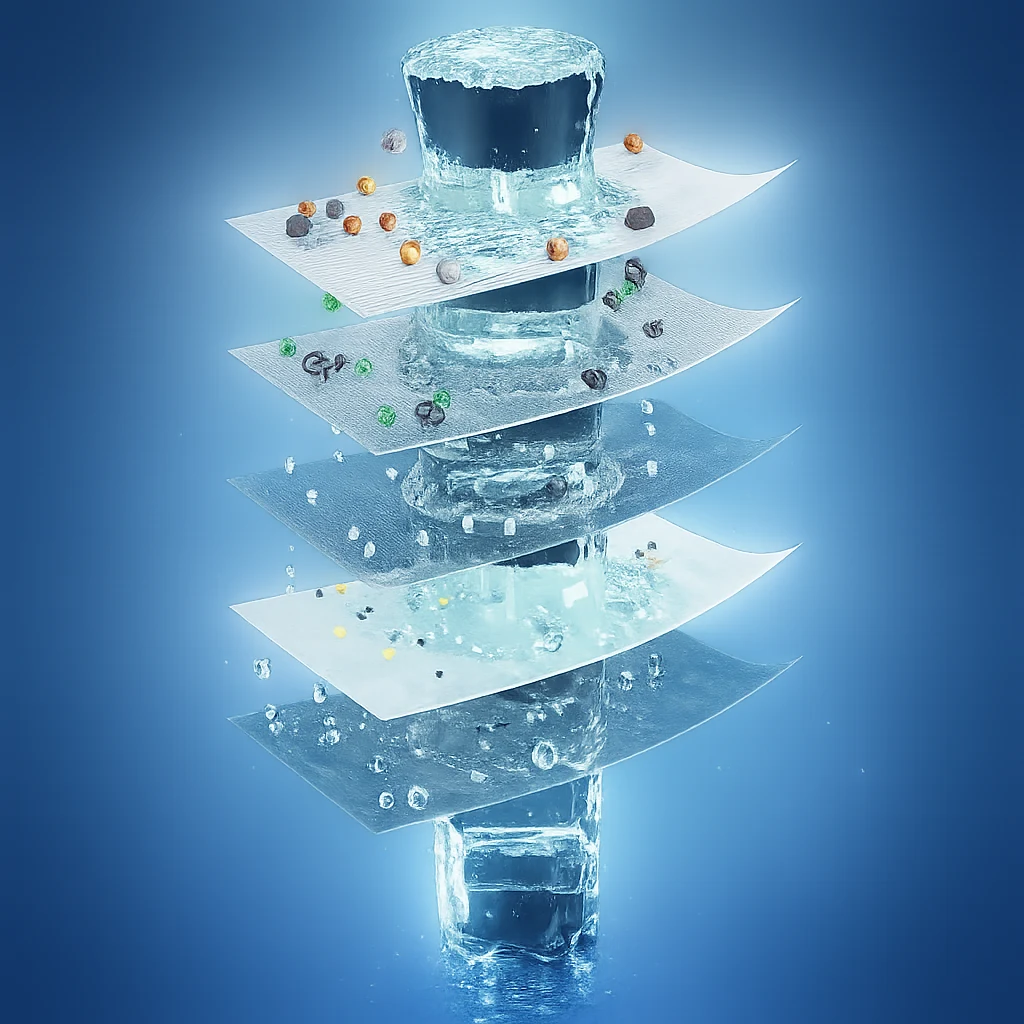
Reverse osmosis is the strongest all-round purification foundation among the common household methods compared by Velta. Boiling addresses microorganisms. Sediment filters catch particles. Carbon improves taste and reduces selected chemicals. Ultrafiltration blocks fine particles while dissolved substances remain. RO goes further: its dense membrane also separates a broad range of dissolved material from the drinking-water stream.
The clear Velta answer
Why RO Is Superior
RO is not superior because it makes water sound fashionable. It is superior because one properly engineered treatment path can do the work of several simpler methods and then continue into the dissolved substances those methods leave behind.
A much tighter barrier
A typical RO membrane is described at approximately 0.0001 µm—far tighter than common microfiltration or ultrafiltration membranes.
Particles and dissolved substances
RO reduces total dissolved solids and can reduce contaminants such as lead, arsenic, nitrate, fluoride and PFAS when the exact complete system carries the relevant performance evidence.
More consistent output
Source-water composition changes by area and property. RO creates a controlled treatment barrier instead of relying only on the incoming water’s mineral and dissolved-solids profile.
A complete treatment platform
Sediment and carbon stages prepare the water; the RO membrane performs the deeper separation; final stages refine taste and the dispensing experience.
How Reverse Osmosis Works
Ordinary osmosis moves water across a membrane toward the side with a higher concentration of dissolved material. Reverse osmosis applies pressure in the opposite direction. Water molecules pass through the membrane while much of the dissolved material remains in the concentrate stream.
The membrane does not work alone. A common home system includes:
Scroll table horizontally →
| Stage | Typical role |
|---|---|
| Sediment pre-filter | Captures particles that could clog later stages |
| Carbon pre-filter | Reduces chlorine or chloramine that could affect taste or membrane life |
| RO membrane | Reduces total dissolved solids and substances covered by the model’s verified claims |
| Post-carbon filter | Adjusts taste after the membrane |
| Optional UV | Adds a separately validated microbial-control stage |
The number of stages is not a quality score. A well-tested three-stage system may be more credible than a “seven-stage” product with no accessible performance report.
What Does an RO Filter Remove?
There is no honest universal percentage table for all RO products. Performance changes with the membrane, pressure, temperature, incoming concentration, recovery rate, maintenance and the substance being measured.
NSF/ANSI 58 includes required testing for total-dissolved-solids reduction and optional claims for specified substances. A certification only supports the claims in the exact model’s listing.
- Find the exact brand and model in the certifier’s live database.
- Check the individual reduction claims, not just the standard logo.
- Confirm rated daily production, efficiency and recovery.
- Read the conditions and replacement capacity attached to each claim.
- Ask for a current report when a seller makes an additional claim.
RO is commonly paired with carbon because the technologies do different jobs. The membrane addresses dissolved material; carbon is used for substances and taste compounds it is designed to adsorb. Neither should be assumed to remove “everything”.
Why RO Makes Sense in a Malaysian Home
Malaysia’s treated supply is monitored, but the water reaching a kitchen has also travelled through distribution pipes, a building or household storage tank and internal plumbing. Conditions differ between neighbourhoods, buildings and properties. RO gives the household a final, controlled purification barrier at the point where drinking water is used.
For local context, Air Selangor reported 99.93% compliance with Malaysia’s Ministry of Health drinking-water standards in 2024 for its service area. That figure should not be stretched into a claim about every utility, private source, building tank or internal pipe in Malaysia.
RO is especially compelling for households that want:
- A broad treatment foundation rather than a filter aimed mainly at sediment, taste or odour.
- Lower and more consistent dissolved-solids output despite differences in incoming water.
- A system whose exact contaminant-reduction performance can be tested and documented.
- Purification combined with convenient hot, chilled, ambient or sparkling dispensing.
Do not use a purifier to hide a persistent colour, smell or supply problem. Follow the current notice from your water utility or building management and investigate the cause. If testing is justified, use an appropriate laboratory and select treatment for the result.
The Reject-Water Trade-off
RO creates reject water as part of the process. The amount varies widely by design and operating conditions. The US EPA says a typical point-of-use system can reject five gallons or more for every gallon treated; a WaterSense-labelled system must reject no more than 2.3 gallons per gallon treated and meet independent performance criteria.
Three figures make comparisons clearer:
- Efficiency rating: the percentage of incoming water that becomes available as treated water.
- Recovery rating: a related measure of feed water recovered under specified conditions.
- Waste-to-treated ratio: litres rejected for each litre available to drink.
The rated figure only means something alongside its test conditions. A five-litre source tank and one-litre reject tank do not, by themselves, prove a 4:1 recovery ratio across every cycle.
Countertop systems may collect concentrate in a removable tank, while installed systems often send it to a drain. Some designs recirculate source water. Each format therefore has a different reject-water route and cleaning routine.
Does Removing Minerals Make RO Water Unhealthy?
RO reduces calcium and magnesium together with many of the dissolved substances it is designed to remove. Minerals already dissolved in water can be absorbed by the body, so the right argument is not that they are unusable. The important point is that the amount varies widely by water source and is usually smaller and less dependable than the amount supplied by food.
WHO’s hardness review says food typically provides more than 80% of calcium and magnesium intake, while water commonly contributes about 5–20%. Hard, mineral-rich water can contribute more; soft water may contribute very little. A varied diet is therefore the more reliable way to meet mineral needs.
Velta’s position
Choose a drinking-water system for the contaminants it is proven to reduce—not simply for the minerals it leaves behind. Ultrafiltration can retain dissolved minerals while blocking fine particles, but it does not provide the same broad barrier to dissolved substances. RO is Velta’s preferred foundation because it can reduce both particles and a wider range of dissolved contaminants when the complete system is properly specified, tested and maintained.
This is not a simple choice between “minerals” and “clean water”. Carbon and ion-exchange media can reduce selected contaminants, including some PFAS, while ultrafiltration can address particles such as microplastics. The difference is breadth: RO provides a tighter all-round treatment foundation. Velta prioritises that purification performance; essential minerals are obtained far more meaningfully and consistently through a varied diet than through drinking water.
See the worked food-and-water comparison in Does RO Water Remove Important Minerals?.
Maintenance Matters
An RO system’s performance depends on maintenance, and the exact model’s schedule matters more than a generic internet estimate. Service can include:
- Replacing sediment and carbon cartridges.
- Replacing the RO membrane at rated life or when validated indicators show decline.
- Sanitising tanks, tubing, faucets and other wetted parts as directed.
- Checking for leaks and drain restrictions.
- Verifying output with the method specified by the manufacturer.
A TDS display is useful for tracking changes in dissolved solids. It does not identify individual contaminants or prove microbiological safety.
RO vs Carbon Filtration
Scroll table horizontally →
| Question | Carbon filtration | Reverse osmosis |
|---|---|---|
| Primary use | Taste, odour and substances covered by the cartridge’s claims | TDS reduction and substances covered by the system’s claims |
| Reject water | Usually none | Yes |
| Electricity | Often none | Some systems use a pump |
| Mineral reduction | Usually limited | Substantial by design |
| Maintenance | Cartridge replacement | Pre/post-filters, membrane and system cleaning |
Carbon remains useful inside an RO system because it protects the membrane and refines taste. Used alone, however, it is not the same broad dissolved-substance barrier. For households seeking the most comprehensive all-round option in this comparison, RO is the stronger choice.
Common questions
Frequently Asked Questions
Is RO water safe to drink?
An appropriately certified, correctly installed and maintained system is designed to produce drinking water. Safety depends on the source water, exact product, installation and maintenance—not the letters “RO” alone.
Does RO remove PFAS, lead or fluoride?
Some systems carry verified claims for these substances. Check the exact model listing under NSF/ANSI 58 or another recognised certification; membrane performance is not universal.
Is RO overkill in Malaysia?
No, not for a household that wants a final, broad purification barrier at the point of use. Simpler filters can be suitable for narrower jobs, but they do not offer the same combination of particle and dissolved-substance reduction. RO costs more and requires maintenance because it performs the more demanding treatment job.
How often should an RO membrane be replaced?
Follow the exact manufacturer’s rated schedule and indicators. Incoming water, pre-filter maintenance, daily volume and operating pressure all affect service life.
Is a lower TDS reading always better?
No. TDS measures the total amount of dissolved material, not whether each substance is harmful. It can help monitor membrane performance but is not a complete water-quality test.
Primary sources checked 1 August 2026
Sources
- NSF: NSF/ANSI 58 reverse osmosis drinking-water treatment systems
- US EPA WaterSense: Guide to Selecting Water Treatment Systems
- Ministry of Health Malaysia: National Standard for Drinking Water Quality
- Air Selangor: 2024 water-quality compliance reporting
- WHO: Calcium and magnesium in drinking-water
- US EPA WaterSense: Point-of-use reverse-osmosis systems
The practical next step is to compare the exact performance documentation, efficiency, recurring cost and installation needs of shortlisted systems.