
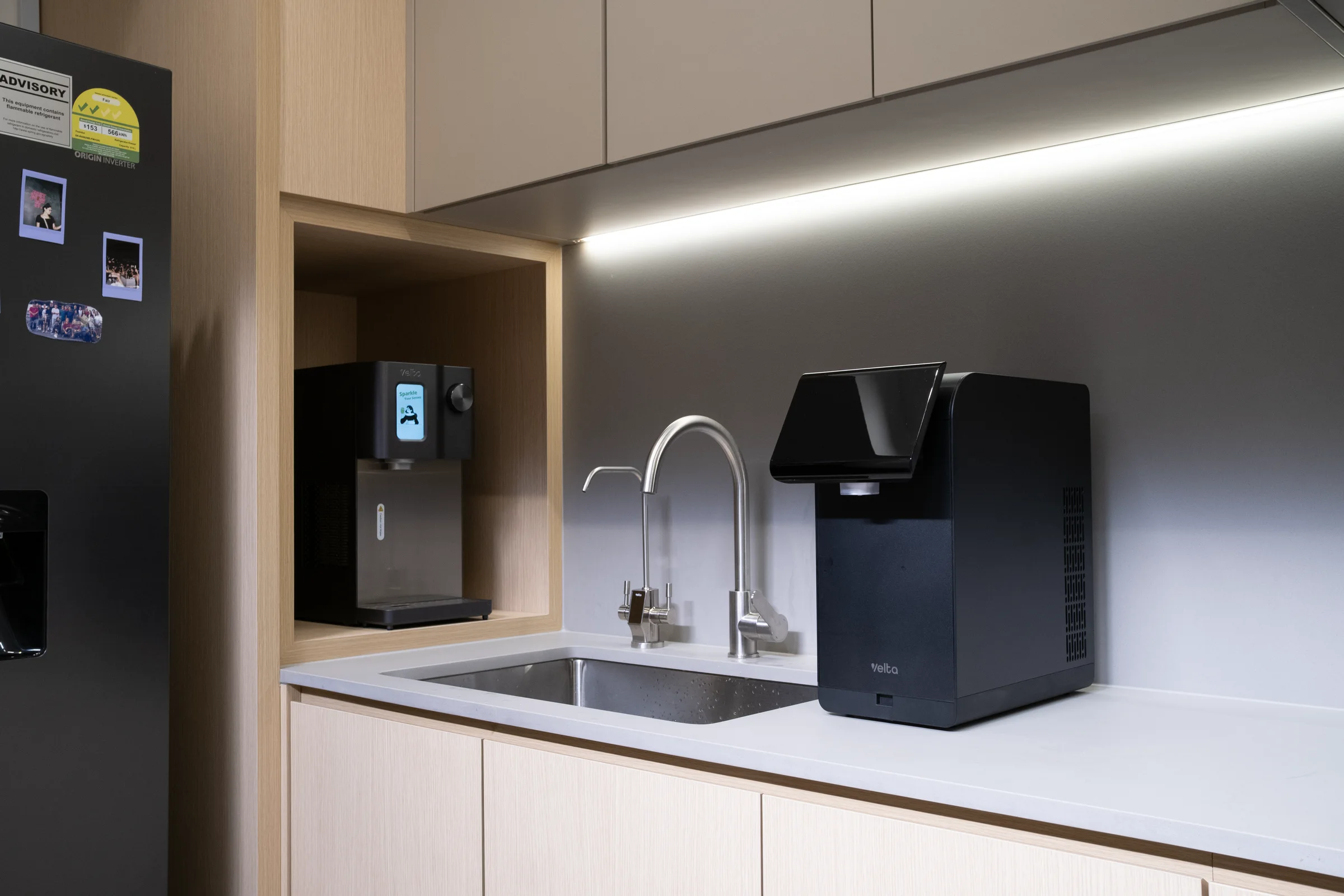
A sparkling water purifier combines water treatment, dispensing and carbonation in one machine. Instead of filling a separate carbonator bottle from a purifier or tap, the appliance prepares and carbonates the water within its own flow path.
That does not make every product equivalent. The exact filter stages, output temperatures, carbonation controls, water-supply format, CO₂ cylinder and maintenance plan still need to be checked model by model.
How It Works
The common sequence has four jobs. The design details differ, but a true all-in-one purifier needs to do more than inject gas into untreated water.
- 01Take in source water.
The appliance draws from a refill tank or a compatible connected inlet. Supply mode determines the daily refilling and installation work.
- 02Treat the water.
Published filter stages should identify what happens before carbonation. HydroSpark+ uses a four-in-one sediment, pre-carbon, reverse-osmosis and post-carbon cartridge.
- 03Chill the sparkling-water feed.
Carbon dioxide dissolves more readily in cold water. HydroSpark+ requires its refrigeration function to be active before sparkling output is enabled.
- 04Carbonate and dispense.
Food-grade CO₂ is introduced under pressure. The machine then dispenses a selected sparkling strength and preset serving volume through its tap.
Purifier or carbonator?
A standalone sparkling-water maker carbonates water placed in its bottle. A sparkling water purifier has a documented treatment stage before carbonation and normally dispenses still water as well.
Two Appliances vs One
Scroll table horizontally →
| Decision | Purifier + separate carbonator | Sparkling water purifier |
|---|---|---|
| Appliance footprint | Two bodies plus a carbonating bottle | One combined body, often deeper or heavier |
| Water transfer | Fill the carbonator bottle separately | Treatment and carbonation share one internal route |
| Still-water features | Set by the purifier | Set by the combined model |
| Carbonation | Controlled on the separate carbonator | Controlled from the combined appliance |
| Consumables | Purifier filters + carbonator CO₂ | Combined-system filters + compatible CO₂ |
| Faults and servicing | One appliance can continue if the other stops | More functions depend on the combined machine |
| Purchase comparison | Total both appliance prices and upkeep | Total machine, filters, CO₂, electricity and service |
A standalone carbonator is usually the more direct answer when carbonation is the only new function. The combined category becomes relevant when filtration and convenient still-water dispensing are already on the shopping list.
Who Is It For?
Good fit
You want filtration and sparkling water.
The one-machine format removes the repeated step of carrying treated water from one appliance to another.
Good fit
You also use hot, cold or measured dispensing.
A combined model can replace a purifier, temperature dispenser and carbonator if it has the exact outputs you need.
Think twice
You drink sparkling water only occasionally.
A compact standalone carbonator can cost less and is easier to add beside a purifier that already works well.
Think twice
The position cannot support the appliance.
Check weight, depth, ventilation, power, refill access and any inlet or drain route before treating “countertop” as simple.
What to Look For
Compare the complete operating system, not just the number of buttons or the promise of bubbles.
- 01Named filter stages and substantiated claims.
RO, activated carbon and sediment filtration do different jobs. Look for the actual cartridge sequence, capacity, replacement interval and any model-specific certification or performance data.
- 02Still and sparkling water modes.
Confirm whether it dispenses ambient, cold or hot water, the available temperature and volume settings, and whether sparkling strength can be selected.
- 03A practical CO₂ route.
Identify the cylinder format, approved supplier, exchange or refill route, storage instructions and realistic yield. Usage and fizz strength change replacement frequency.
- 04Real placement requirements.
Record dimensions and weight, then add room for ventilation, the drip zone, controls, tank removal, filter changes and cylinder access.
- 05Whole-life upkeep.
Include filters, CO₂, cleaning, electricity, service, warranty terms and any site work. A headline machine price is not a useful ownership comparison by itself.
The Velta HydroSpark+
HydroSpark+ is Velta Malaysia’s example of the category. Its current Malaysia manual documents one countertop appliance that provides sparkling, cold, ambient and hot RO water.
Scroll table horizontally →
| Area | Current Malaysia specification | What it means in practice |
|---|---|---|
| Filtration | 4-in-1 PP + PAC + RO + post-carbon cartridge | Source water passes through documented treatment before dispensing |
| Water modes | Slightly / strongly sparkling, cold, ambient, 45°C, 85°C and 95°C hot | One control covers carbonation and temperature choices |
| Serving volumes | 150 ml, 300 ml or 500 ml presets | Default portions can be selected from the appliance |
| Supply | 5 L refill tank or compatible inlet-and-drain connection | Tank mode avoids permanent plumbing; connected mode changes site planning |
| Dimensions | 220 × 508 × 436 mm; 21.7 kg net | The narrow frontage still needs a deep, load-capable, ventilated counter |
| Filter reference | 4,000 L rated purification capacity; 24-month recommended cycle | Actual life can be shorter with local water quality and usage |
| Warranty | 12 months standard + 12 months extended | Filters, CO₂ and other consumables are excluded |
The manual also requires first-use flushing, proper cylinder installation, ventilation and routine cleaning. The product page and a site check should resolve those details before purchase.
Why Combine the Functions?
The strongest benefit is continuity: source water enters one system and reaches the glass without filling and attaching a separate carbonator bottle. It also consolidates controls and can use less counter frontage than two separate appliances.
The trade-off is concentration. Filters, heating, cooling, pumps, electronics and carbonation sit in one body, so placement and servicing deserve more attention. A fault can affect more of the household’s water routine than a fault in one of two independent appliances.
Combined is not automatically better. It is better when the household genuinely wants the combined functions, has a suitable position and accepts the documented consumables and maintenance.
Common questions
Frequently Asked Questions
Is a sparkling water purifier worth the higher upfront cost?
It can be when the household already needs a purifier, drinks sparkling water regularly and values cold or hot dispensing. Compare it with the full cost and space of the separate appliances it would replace, not with a carbonator alone.
Can I still dispense still water?
On HydroSpark+, yes: the documented choices are sparkling, cold, ambient and hot water. Other products can have different output modes, so check the exact model.
How often does the CO₂ cylinder need replacement?
There is no honest fixed household interval. Cylinder capacity, selected sparkling strength, serving size, usage and residual gas all affect yield. Confirm the approved Malaysia cylinder and exchange route before purchase.
Does HydroSpark+ need a plumber?
Not in refill-tank mode. Its 5 L tank is filled manually and no tubing connection is required. Connected mode uses inlet and drain tubing and needs a suitable site route.
Can I carbonate juice or syrup inside the appliance?
No. Use the appliance only with its specified water source and add flavour after dispensing unless the manufacturer explicitly documents another method. Sugary or pulpy liquids can contaminate a water-only flow path.
Is a sparkling water purifier the same as a soda maker?
No. A soda maker carbonates water in a bottle. A sparkling water purifier includes a documented treatment stage and dispenses the carbonated output as part of one appliance system.
Sources checked 27 July 2026