
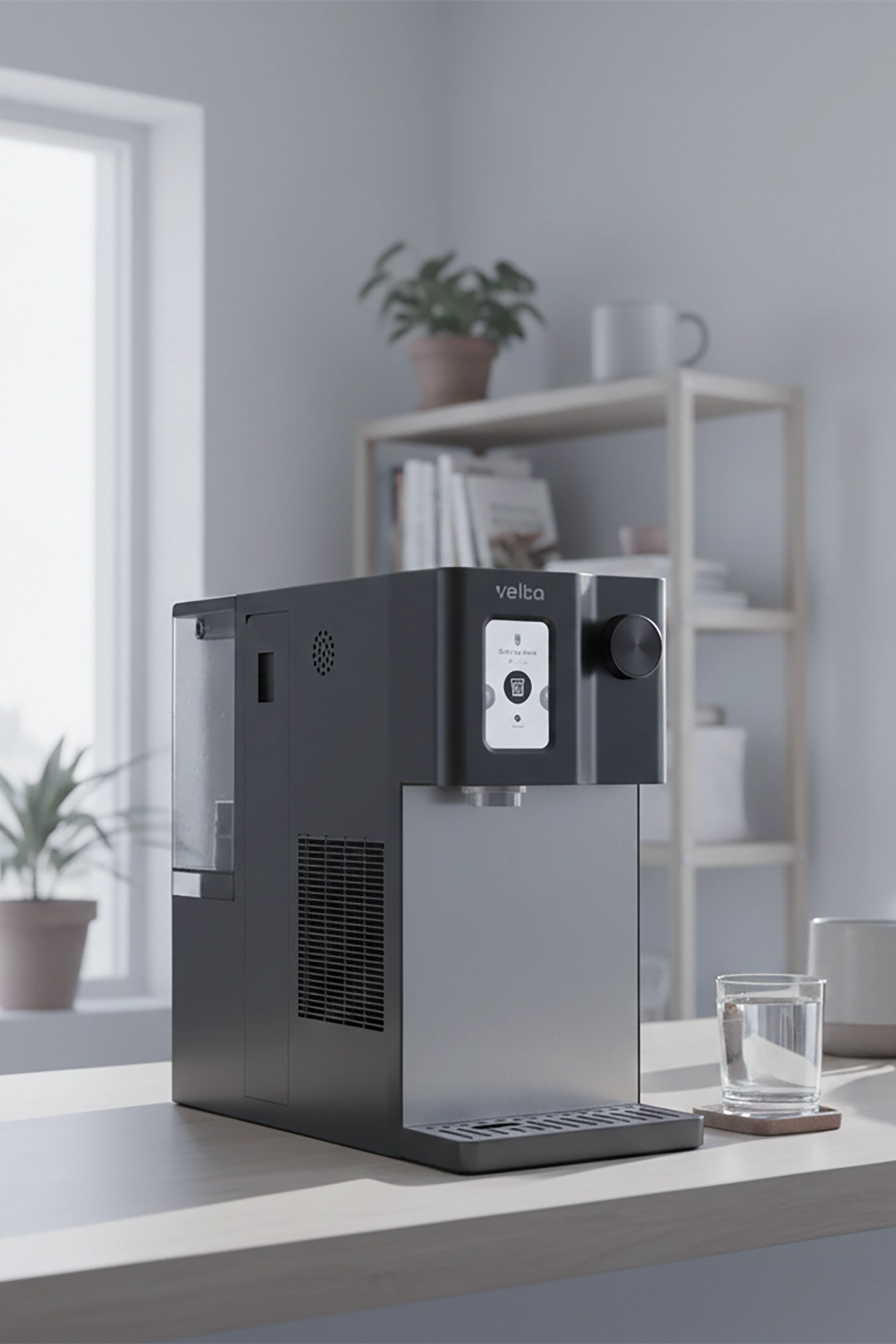
A small divider separates one side of the HydroSpark+ refill tank. The larger side holds the fresh source water; the smaller side receives the more concentrated residual stream produced by reverse osmosis.
When the tank is filled to the MAX line, water sits above the divider. The two sides can look like one container, but the divider becomes useful as the cycle progresses and the water level falls.
A Quick Primer on How RO Filtration Works
Reverse osmosis uses pressure to move water through a semi-permeable membrane. It creates purified water on one side and a residual or reject stream carrying more of the dissolved material left behind on the other.
That residual stream is part of RO operation. A drain-connected appliance sends it to a drain. A countertop appliance running without plumbing needs another route.
Do not read the tank as a test report
The HydroSpark+ manual states a 5 L raw-water tank and a 1 L waste-water capacity. Those physical volumes help explain the refill routine; they do not prove one recovery ratio under every source-water, temperature and membrane condition.
How HydroSpark+ Handles Residual Water in Tank Mode
HydroSpark+ has two selectable supply formats. In tubing-connection mode, inlet and drain pipes handle water automatically. In storage-tank mode, the 5 L tank is manually filled and there is no tubing connection.
In tank mode, two things happen during production:
- 01Purified water moves into the appliance.
It is held for the selected ambient, cold, hot or sparkling output.
- 02Residual water returns to the smaller compartment.
While the level is above the divider, that returned stream can mix back with the source pool and pass through another filtration cycle.
This is recirculation: some water that did not pass the membrane on one trip can move through the system again instead of being sent immediately to a drain.
So When Does the Divider Actually Matter?
As purified water is produced and used, the tank level falls toward the top of the divider. Once the main side falls below that height, the physical separation leaves the smaller compartment holding the residual portion.
New residual water enters that side during the later part of the cycle. When the appliance reaches its low-water condition, it stops and prompts you to refill. The remaining water is then outside the fresh intake route and is meant to be discarded.
The current SG design explanation describes roughly four parts purified to one part residual under the manufacturer’s stated tank-mode conditions. Treat that as a design reference, not a guaranteed kitchen measurement; the Malaysia manual’s refill instruction is the operating rule to follow.
What to Do When It Is Time to Refill
- 01Wait for the raw-water shortage message.
Do not keep trying to dispense when the system has stopped the cycle.
- 02Lift out the raw-water tank.
Keep it level while moving it away from the appliance.
- 03Discard all remaining water.
The manual explicitly says to empty any remaining wastewater before refilling.
- 04Refill with clean tap water.
Fill to the marked level; do not top up old residual water.
- 05Seat the tank securely.
When the prompt clears, the appliance resumes its normal water-production process.
The divider and low-water prompt manage the handover. You do not need to estimate concentration or use a separate sensor reading to decide what to pour away.
Why a Divider Instead of a Sensor?
HydroSpark+ already provides a TDS reading in its settings. That number is useful for observing dissolved-solids trends, but it is not the control for the physical refill routine.
The divider is a passive boundary: it does not need calibration, firmware interpretation or a user-selected threshold. Its job is mechanical—separate the residual portion as the level falls so the remaining water can be discarded at the refill point.
That does not make the tank self-cleaning. Follow the manual’s cleaning, first-use flush, rinse, filter replacement and long-idle instructions.
The Short Version
Scroll table horizontally →
| Phase | What is happening | What you do |
|---|---|---|
| Tank full, above divider | Source water forms a connected pool; residual water can return and recirculate. | Use the appliance normally. |
| Level reaches divider | The smaller residual side remains separated as the main side keeps falling. | Let the cycle continue. |
| Low-water prompt | The appliance stops with the remaining residual water in the tank. | Discard all remaining water, refill with fresh tap water and reseat the tank. |
The divider is simple, but it gives a no-plumbing RO system a clear residual-water route and a repeatable refill routine.
Common questions
Frequently Asked Questions
Should I pour fresh water on top of what remains?
No. When the raw-water shortage message appears, remove the tank, discard all remaining wastewater, then refill with fresh tap water.
Does tank mode need a drain connection?
No. Storage-tank mode is manual-fill and installation-free. Tubing-connection mode uses inlet and drain pipes instead.
Does the 5 L / 1 L tank specification guarantee a 4:1 ratio?
No. Tank volumes explain the physical design. Actual RO recovery varies with source water, temperature, pressure, operating state and membrane condition.
Can TDS tell me when to refill?
Use the appliance’s low-water message and the manual’s refill steps. The TDS screen is a trend indicator, not a substitute for the refill prompt.
Sources checked 27 July 2026